
The Blind Librarian, I
A Review in Quotes of The Book of the New Sun, Chapter VI. The Master of the Curators

in which Severian descends into darkness
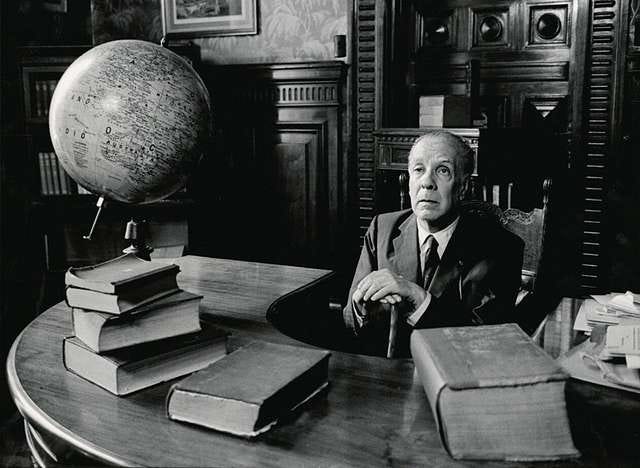
Greetings, fellow apprentices,
With this entry, we enter Ultan’s library (not to be confused with the excellent Wolfe fan site of the same name), and I think we will have to linger here for several entries. I’ve copied out several pages worth of quotes, and even if I write an entry for each, I don’t think I’ll exhaust the rich potential of Chapter VI, “The Master of the Curators.”
Reading this one again, I’m struck by just how much of what’s here carries the very essence of what makes this book so meaningful to me, and has caused it to stick with me over nearly two decades now. And clearly, as the title of the fan site suggests, I’m not alone. I think it’s worth pausing here for awhile, as if lingering in the titular library itself, treating the sentences and paragraphs like books in themselves — which, of course, at least in a certain Borgesian sense (which I will explain in due course) they are. And we will have occasion to discuss some of Wolfe’s influences, not least including Jorge Luis Borges and Marcel Proust, as we divine our way to the heart of the mystery of what makes a literary work endure. I’m exaggerating a little, but only a little, when I say that even if the rest of The Book of the New Sun had been a dud, this chapter alone might have cemented its place in the collective literary imagination.
But this is a review in quotes, so let’s get into a quote. I’m going to break form just a bit, by starting with one not from this chapter, but from the end of the last, not merely because the transition is masterful, but because this chapter seems almost to begin with the ending of the last.
...I walked through the arch the old man had indicated. Like the rest of that vaulted hall, it was of dull, reddish brick, but it was upheld by two pillars whose capitals bore the faces of sleepers, and I found the silent lips and pale, closed eyes more terrible than the agonized masks painted on the metal of our own tower.
Each picture in the room beyond contained a book. Sometimes they were many, or prominent; some I had to study for some time before I saw the corner of a binding thrusting from the pocket of a woman’s skirt or realized that some strangely wrought spool held words spun like thread.
The steps were narrow and steep and without railings; they twisted as they descended, so that I had not gone down more than thirty before the light of the room above was nearly cut off. At last I was forced to put my hands before me and feel my way for fear that I would break my head on the door.
My questing fingers never encountered it. Instead the steps ended (and I nearly fell in stepping off a step that was not there), and I was left to grope across an uneven floor in total darkness.
“Who’s there?” a voice called. It was a strangely resonant one, like the sound of a bell tolled inside a cave.
Severian’s passage through the arch is the crossing of a threshold, and even a crossing into the next chapter while we’re still in this one. The two “sleepers” with their “silent lips and pale, closed eyes,” more terrible to Severian even than faces twisted in the agony of torture (one suspects from familiarity with the latter) — those pale, closed eyes herald blind Ultan, whom we are shortly to meet.
Then we have a gallery of paintings, each containing books, whether a profusion of them or single well-hidden volume. The book in the woman’s skirt prefigures the “cube of crystal...no larger than your thumb that contains more books than the library itself does,” which “a harlot might dangle...from one ear for an ornament.” The “strangely wrought spool” with its “words spun like thread” prefigure other exotic forms of books that Ultan will describe, which we will save for another entry.
Next we follow Severian down the stairs, in a paragraph that conveys with an easy, visceral physicality his precarious, haphazard descent into darkness. Is Severian entering a tomb? Or a womb? We will see that it is a bit of both, as he and Ultan will speak both of death and of life, and the positioning of this episode in the narrative, marking the beginning of Severian’s relationship with the Chatelaine Thecla, signals another death and resurrection for him. Severian never actually encounters the door itself, despite Rudesind’s directions, suggesting the invisible nature of such transitions. We don’t always recognize those moments in which our lives are changed forever, or as is the case here, the preludes to those moments.
And finally we hear Ultan’s voice, “like the sound of a bell tolled inside a cave.” The simile of Ultan and the tolling bell is an extended one. To wit, when Ultan summons Cyby for some light: The name rang through the dark corridors I sensed all about me as the iron tongue struck the echoing bronze on one side, then the other.
The gap between chapter endings and beginnings are wonderfully liminal spaces in books. They can mark the passage of years, or even centuries; or, as here, they can signal no passage of time at all. So now we are in the next chapter, but not in the next chapter; we are in Ultan’s library, yet not in the library.
Now is as good a time as any to meet Jorge Luis Borges, if you have not yet had the pleasure. But I think that may merit its own excursus. And you know I love a good excursus. So we will leave off here for now, and next time we will meet Borges, before we meet Ultan, once again, for the first time.

But before we do that, I want to end this entry with a real-life account of the magic of libraries (I, who have not set foot in a library for many years, but that will change as my sons grow older). This is from Joseph Mazur’s Enlightening Symbols: A Short History of Mathematical Notation and Its Hidden Powers.
Many years ago, I had a few rare moments of being permitted to flip through the oldest surviving copy of Euclid’s Elements, MS D’Orville 301. It was the privilege of a favored few...no easier than getting permission to visit the queen in her drawing room...on the day of appointment, a man greeted me in the lobby outside the Special Collections room of the Bodleian Library at Oxford. The gaunt man with a Lincoln-looking face, bushy eyebrows, and sunken cheeks escorted me to a room where he administered an oath.
Do fidem me nullum librum vel instrumentum...
	*I hereby undertake not to remove from the Library, nor to mark, deface, or injure in any way, any volume, document, or other object belonging to it or in its custody; not to bring into the Library, or kindle therein, any fire or flame, and not to smoke in the Library; and I promise to obey all the rules of the Library.*
...Next, I was presented with a pair of white gloves and asked to sign the Euclid MS D’Orville 301 guest book with a special pen. I must have hesitated oddly as I glanced at the page I had just signed, for I unexpectedly realized that my signature might be on that page for the next thousand years, just twelve lines below Isaac Newton’s.
...
I was left alone in the room with this magnificent document. I cannot tell you how electrified and privileged I felt to be alone in a room with such an ancient manuscript. I was a monk in a medieval monastery, a count in my Bohemian library, Newton pondering over the question of why there were no symbols in the codex. Alone in that room I felt a spiritual connection to all the past scholars, scribes, mathematicians of the last millennium, and especially to Stephan the Clerk, who in 888 AD laboriously copied the work onto parchment for Arethas of Patras...
Mazur’s account, rightly considered, is objectively no less wonderful than our encounter, through Severian’s eyes, with Ultan; yet the wonder of actual reality seems to nearly always have the volume turned down, the same way our immediate, physical existence seems so dull compared to what we see on our glowing screens. We need works like The Book of the New Sun to serve as icons into reality, kindling our minds with a sense of vast and impenetrable mysteries.
If this is escapism, it is only so in the sense in which Tolkien approved of it in “On Fairy-Stories”:
I have claimed that Escape is one of the main functions of fairy-stories, and since I do not disapprove of them, it is plain that I do not accept the tone of scorn or pity with which “Escape” is now so often used: a tone for which the uses of the word outside literary criticism give no warrant at all. In what the misusers are fond of calling Real Life, Escape is evidently as a rule very practical, and may even be heroic. In real life it is difficult to blame it, unless it fails; in criticism it would seem to be the worse the better it succeeds. Evidently we are faced by a misuse of words, and also by a confusion of thought. Why should a man be scorned if, finding himself in prison, he tries to get out and go home? Or if, when he cannot do so, he thinks and talks about other topics than jailers and prison-walls? The world outside has not become less real because the prisoner cannot see it. In using escape in this way the critics have chosen the wrong word, and, what is more, they are confusing, not always by sincere error, the Escape of the Prisoner with the Flight of the Deserter.
That is, great fantasy allows us to escape from the apparently mundane aspect of reality, into a more enchanted realm that, if it is also something I’ll call “literary” for lack of a better word, will return us to reality with the sense that it really is enchanted, after all.
‘til next time,
⃤ AR